Tried and Tested IELTS Exam Tips - Listening, Writing, Reading, Speaking from an IELTS Reviewer
Useful Apps for IELTS Teachers
Are you planning to teach a friend who needs help building their skills for the IELTS or the International English Language Testing System examination?
Teaching IELTS can be pretty difficult if you do not have the right materials to use for the class. IELTS mentors have undergone training and classes to hone their English skills and their knowledge for the examination format itself. Additionally, most of them have already taken the test making them authorities in teaching the IELTS. Though they are already professionals in the IELTS, these mentors are also guided by books, manuals, and even apps for the IELTS. Here are some apps these coaches use in their training for the IELTS.
1. IELTS Word Power
http://www.britishcouncil.org/spain/en/ielts-word-power

Aren’t you surprised why these mentors have the best and the widest vocabulary while teaching? This app helps mentors in knowing and understanding words that are best to be used in the IELTS. Having wide vocabulary is a great advantage for the IELTS examination.
2. IELTS Skills
http://www.appannie.com/apps/ios/app/ielts-skills-free/

With all four sections of the IELTS in a single app, no one can go wrong downloading this app. Practice tests and interactive tasks are conveniently added in this feature. Each skill has explanations that mentors can practice and exercises that comprehensively test their skills for the IELTS.
3. IELTS Speaking Practice
https://play.google.com/store/apps/details?id=com.dmc.iespeaking2&hl=en
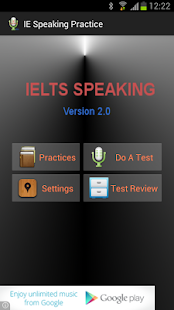
With over 300 questions, coaches are always prepared to conduct speaking tests with their enrolees. The variety of topics makes this app perfect for honing skills and developing better answers for the IELTS speaking examination.
4. Practice English Grammar 2
https://itunes.apple.com/us/app/practice-english-grammar-2/id490759167

Problems with grammar? This app will sort things out with queries on grammar. It has practically discussions and exercises on verb tenses which are a problem to most candidates. Provided with examples and sample tests, this app is one you should have on your smart phones and tablets.
5. Merriam-Webster Dictionary
https://itunes.apple.com/ph/app/id399452287?mt=8

Be more familiar with words and jargons in the reading texts with this handy dictionary. It provides easy to understand definition of words and sample sentences. Moreover, if connected to the internet, one checks the pronunciation of a certain vocabulary word.
These apps are very helpful to teachers teaching the IELTS. However, not only teachers can use this but also the students reviewing for the IELTS. Having them on your smart phones is the best way to review for the IELTS examination especially when you are always on the go.
TOEFL for Filipino Physical Therapists
Several questions have been circling around Filipino physical therapists about applying for work overseas. The opportunities offered to these professionals have been increasing over the years. To meet these demands, Filipino physical therapists comply with the different requirements these agencies need. For starters, Filipino physical therapists prepare by taking the NPTE or the National Physical Therapy Examination.
One step of the process is credentialing. The FCCPT or the Foreign Credentialing Commission on Physical Therapy offers Educational Credentials Review Service. This service is used for licensure to practice physical therapy in the United States of America. People who are seeking to be awarded with a license to work as a physical therapist should apply for this. What this service does is to compare the educational records provided by the applicant to the current requirements for the first professional degree in the US. It will determine whether the education attained is equivalent to that of a graduate of an accredited physical therapy degree program in the Unites States.
Once credentialing has been completed, Filipino physical therapists prepare taking an English competency examination, specifically the Test of English as a Foreign Language (TOEFL). This English proficiency examination is conducted by ETS that aims to provide a certificate of one’s competency in the English language represented by scores. The test is composed of four different sections – the reading, listening, speaking and the writing. The need for the TOEFL score is important as it has been a requirement prior to taking the NPTE.
However, not all states require a TOEFL score before taking the NPTE. What candidates for the NPTE need to do is to verify on the state they are applying whether the TOEFL is needed or not. There could be individuals questioning the important of the TOEFL. Why do they need to take this test?
The TOEFL test is an English proficiency examination that evaluates how well a candidate can use the English language. Through the TOEFL, companies and health care institutions are guaranteed that they have people working for them who can understand the English language. Furthermore, people who would be working overseas, especially in an English-speaking country, need to communicate in English not only at work but also in the environment outside work.
Therefore, the TOEFL examination is important for any individual who is planning to work overseas. For Filipino physical therapists, the need for the TOEFL score depends on the state where they are applying for. All they have to do is to inquire whether they need the TOEFL before taking the NPTE.
Free Online Resources to Practice TOEFL Speaking Exam
Is it really tough to speak English?
Many Filipinos are good at speaking in the English language. This is due to the reason that English has been incorporated in the medium of instruction in schools in the Philippines. Hence, it is not surprising why Filipinos can communicate in the English language. Though accustomed to using the language, Filipinos still need to take an English competency examination when they need to work or study abroad. This exam will provide evidence that they are proficient in English. The Test of English as a Foreign Language (TOEFL) is one English proficiency examination that is widely taken by Filipinos today.
Many Filipinos are good at speaking in the English language. This is due to the reason that English has been incorporated in the medium of instruction in schools in the Philippines. Hence, it is not surprising why Filipinos can communicate in the English language. Though accustomed to using the language, Filipinos still need to take an English competency examination when they need to work or study abroad. This exam will provide evidence that they are proficient in English. The Test of English as a Foreign Language (TOEFL) is one English proficiency examination that is widely taken by Filipinos today.
The TOEFL has four language skills – reading, listening, writing and speaking. The speaking part of the test is where the candidate’s skills in creating responses to questions and situations. Most of the time, Filipinos enrol in TOEFL review centers as they provide training on how to answer TOEFL speaking exam questions effectively. Additionally, as a candidate for the said examination, you can also try doing practice tests online all by yourself. Here are some online resources you can do for free in preparing for the TOEFL speaking examination.
· English Club http://www.englishclub.com/esl-exams/ets-toefl-practice-speaking.htm
This is a good start for candidates to practice for their speaking. The exercises offered in this site will help the candidate know better the tasks as the transcript and the sample responses are provided. Candidates will get the chance to check their responses if it is right.
· Practice Speaking English Online for the TOEFL Test http://englishteststore.net/index.php?option=com_content&view=article&id=11397&Itemid=170
The exercises found in this site are really helpful. Candidates have the chance to record their responses and save it. You would also hear responses from other people who have answered the same question and leave comments. This is a good way of learning how to effectively answer on some tasks for the TOEFL Speaking exam.
· TOEFL Speaking Network http://www.toeflspeakingnetwork.com/
There is a payment when you want to join this group; however, there are exercises that are available for free where you can practice on. In addition, there are sample responses available to make candidates compare their own responses and check the similarity.
·URCH http://www.urch.com/forums/toefl/146216-toefl-ibt-speaking-rescore-24-26-a.html
If you want to share some questions or information regarding the TOEFL test, this site is where candidates in the TOEFL post comments and recommendations on useful materials for practice in the TOEFL. It is always helpful to find people who share the same feelings with you in the TOEFL.
Gear up as you develop your speaking skills with the best coaches in town. Practice on these sites all by yourself and get more training on the speaking test in TOEFL review centers. You can also refer to this post to avoid common mistakes in the TOEFL speaking exam - common topics are here.
IELTS and TOEFL – Which is More Applicable for Filipino Nurses in the US?
The nursing profession is very popular here in the Philippines. Its popularity is evident as the number of enrolees in nursing schools here in the Philippines has been increasing for the past few years. Many students have been taking the nursing course because of the demand for Filipino nurses in the United States of America.
In planning to work abroad, specifically in the US, it is best for candidates to gain experience here in the Philippines prior to working outside the country. Health institutes and hospitals abroad look for nurses with experience prior to employing them. Aside from the work experience, one requirement that these hospitals and health care institute particularly need is a certification from an English proficiency examination. Nurses can choose between the International English Language Testing System (IELTS) or Test of English as a Foreign Language (TOEFL).
How are these two different?
The TOEFL is a computer-based examination that focuses on academic content. It has four language skills – the reading, listening, speaking and writing. The test runs for about four hours with a ten-minute mandatory break between the first set of exam (reading and listening) and the second set of exam (speaking and writing). The highest score one can get from the TOEFL examination is 120 with a perfect score of 30 in the four language skills.
The IELTS is a paper-based examination that has a broader scope of topics. It also uses the four core skills – speaking, listening, reading and writing. Most of the time, the speaking test is completed a couple of days before the writing exams. The speaking test runs for about ten to fifteen minutes and the writing exams runs for about three hours. The IELTS examination is divided into two types – the Academic and the General Training module. Academic Module is taken by individuals planning to study and work abroad like nurses. General training is often taken by individuals who wish to migrate or study a course less than six months. Scores in the IELTS are in bands from 0 -9.
Which of these tests are more applicable to nurses for US?
Both are recognized English proficiency tests and both provide accurate and comprehensive examinations. For Filipino nurses, the best thing to do is to check the state where they are applying. Some states require the TOEFL; whilst some need the IELTS or even accept both. The safest way is to check the state’s requirements or even ask a consulting firm regarding this issue.

Effective Techniques for IELTS Listening Exam
Are you having problems listening to English conversations? Have you experienced misunderstanding words that you end up confused?
There are some people who really find listening to English conversations a little difficult, most especially if the speakers are using Australian accent or British Accent. American accent is somehow far better to understand than the two accents mentioned earlier. In addition, there are times that individuals feel a little awkward and sometimes even feel nervous when asked to listen to English conversations. Furthermore, if you are an individual taking the International English Language Testing System examination or the IELTS exam, you had better develop and sharpen your listening skill for it is surely to be tested and evaluated in the examination. Having this said, what are some effective techniques for the listening section of the IELTS examination?
• Familiarity with words spoken in Australian or British accent.
In the listening section, you are sometimes asked to fill in the blanks regarding information found in the conversation or audio recording. Certain words are pronounced quiet differently in the accents mentioned compared to American English. Another thing that you have to be familiar with is the words and expressions that are used. For example, the word “apartment” is “flat” in Australian or British vocabulary. Expanding vocabulary in the accents used will bring advantage to you.
• Following instructions carefully.
Let’s say you are good at listening but you always overlook the instructions in each section. Still, you will get a low score on your listening. There are a lot of candidates who are very careless that they skip the instruction as they already feel accustomed to the test type. Always remember that if the instructions asked you to write no more than three words, then you have to write a maximum of three words. If you are asked to circle three answers, then follow it. Failure to do such will cause loss of points to your listening score.
• Stay focused on the audio recording.
Once you are going to answer another item. Skip over it and take note of the key words that you have to find in the audio recording. Once the audio is played, focus. Do not let your mind wander but stay on track with the audio recording. The more you are focused, the easier for you to get the details that you need for the questions.
There are still lots of techniques one can acquire for the listening exam of the IELTS. It is suggested for an individual to enrol in an IELTS review center to take advantage of these skills and be prepared for the real IELTS examination.
The Prepositions: AT, ON, IN
It is a constant reminder to anyone who is taking any English competency examination to have a good background in grammar. Grammar is the basic foundation one must have to be able to speak and write in English. There are eight parts of speech in English namely; nouns, pronouns, verbs, adjectives, adverbs, conjunctions, interjections and the considered one of the most difficult because of its varied rules in grammar – prepositions.
What are prepositions?
Prepositions are words that link a word or a phrase to a part of the sentence. It is entirely different from a conjunction as a conjunction connects two grammatically alike sentences. Meaning to say, conjunctions connect a word to a word, a phrase to a phrase and a clause to another clause.
Prepositions are used in grammar very often. Hence, it is important for us to know the rules on the basic and most commonly used prepositions – in, on, and at.
Prepositions In, On, At as Time prepositions
"in" can be used with the following:
• parts of the day
I was here in the morning.
I have set a meeting with Mr. Bo in the evening.
In the afternoon, the children take a nap in the living room.
• months, years, seasons
The Kims are going back to Korea in December.
In 1985, my younger brother was born.
My parents usually hire a cabin in the woods in spring.
In 1985, my younger brother was born.
My parents usually hire a cabin in the woods in spring.
"on" can be used with:
• days and dates
The president is said to have a meeting with his cabinet members on Tuesday.
Philippines got its independence from the Spaniards on June 12.
Philippines got its independence from the Spaniards on June 12.
• special days
On Christmas, we always go to the ski resort.
There is a big feast in my aunts on Independence Day.
"at" can be used with:
• specific time of the day
I usually get up at 8 o’clock in the morning. How about you?
Class starts at 7.20 am.
Class starts at 7.20 am.
• the following expressions: at night, at midnight, at noon, at sunrise, at sunset, at the moment
I can hear wolves howling at night by the cliff.
Do you eat lunch at noon?
Do you eat lunch at noon?
Prepositions In, On, At as Place prepositions
The preposition in is used to describe an object or a person within the area of something or within the confines of something.
Examples:
The children are busily doing an experiment in the laboratory.
Davao City is in Mindanao.
What is in your bag?
The preposition on is used to describe that something is on or against another surface of something.
Examples:
The books that I bought are placed on the table.
The cat is sleeping on the sofa.
A huge wall clock is placed on the wall.
Finally, the preposition at is used when writing a complete address.
Examples:
I live at 34 St. Coral Avenue, Toril, Davao City.
Her favorite flower shop is at 1423 Main Street.
Examples:
I live at 34 St. Coral Avenue, Toril, Davao City.
Her favorite flower shop is at 1423 Main Street.
In addition, you can also use at to show a specific point or location.
Examples:
Examples:
Rhea is working at her desk.
I work at a bank.
I saw her standing at the entrance of the building.
Being familiar with the basic usage of these prepositions is essential in writing and in speaking. Practice more on these and remember the rules very well.


