Showing posts with label ielts training. Show all posts
Tried and Tested IELTS Exam Tips - Listening, Writing, Reading, Speaking from an IELTS Reviewer
Useful Apps for IELTS Teachers
Are you planning to teach a friend who needs help building their skills for the IELTS or the International English Language Testing System examination?
Teaching IELTS can be pretty difficult if you do not have the right materials to use for the class. IELTS mentors have undergone training and classes to hone their English skills and their knowledge for the examination format itself. Additionally, most of them have already taken the test making them authorities in teaching the IELTS. Though they are already professionals in the IELTS, these mentors are also guided by books, manuals, and even apps for the IELTS. Here are some apps these coaches use in their training for the IELTS.
1. IELTS Word Power
http://www.britishcouncil.org/spain/en/ielts-word-power
Teaching IELTS can be pretty difficult if you do not have the right materials to use for the class. IELTS mentors have undergone training and classes to hone their English skills and their knowledge for the examination format itself. Additionally, most of them have already taken the test making them authorities in teaching the IELTS. Though they are already professionals in the IELTS, these mentors are also guided by books, manuals, and even apps for the IELTS. Here are some apps these coaches use in their training for the IELTS.
1. IELTS Word Power
http://www.britishcouncil.org/spain/en/ielts-word-power

Aren’t you surprised why these mentors have the best and the widest vocabulary while teaching? This app helps mentors in knowing and understanding words that are best to be used in the IELTS. Having wide vocabulary is a great advantage for the IELTS examination.
2. IELTS Skills
http://www.appannie.com/apps/ios/app/ielts-skills-free/

With all four sections of the IELTS in a single app, no one can go wrong downloading this app. Practice tests and interactive tasks are conveniently added in this feature. Each skill has explanations that mentors can practice and exercises that comprehensively test their skills for the IELTS.
3. IELTS Speaking Practice
https://play.google.com/store/apps/details?id=com.dmc.iespeaking2&hl=en
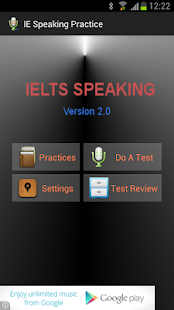
With over 300 questions, coaches are always prepared to conduct speaking tests with their enrolees. The variety of topics makes this app perfect for honing skills and developing better answers for the IELTS speaking examination.
4. Practice English Grammar 2
https://itunes.apple.com/us/app/practice-english-grammar-2/id490759167

Problems with grammar? This app will sort things out with queries on grammar. It has practically discussions and exercises on verb tenses which are a problem to most candidates. Provided with examples and sample tests, this app is one you should have on your smart phones and tablets.
5. Merriam-Webster Dictionary
https://itunes.apple.com/ph/app/id399452287?mt=8

Be more familiar with words and jargons in the reading texts with this handy dictionary. It provides easy to understand definition of words and sample sentences. Moreover, if connected to the internet, one checks the pronunciation of a certain vocabulary word.
These apps are very helpful to teachers teaching the IELTS. However, not only teachers can use this but also the students reviewing for the IELTS. Having them on your smart phones is the best way to review for the IELTS examination especially when you are always on the go.
Effective Techniques for IELTS Listening Exam
Are you having problems listening to English conversations? Have you experienced misunderstanding words that you end up confused?
There are some people who really find listening to English conversations a little difficult, most especially if the speakers are using Australian accent or British Accent. American accent is somehow far better to understand than the two accents mentioned earlier. In addition, there are times that individuals feel a little awkward and sometimes even feel nervous when asked to listen to English conversations. Furthermore, if you are an individual taking the International English Language Testing System examination or the IELTS exam, you had better develop and sharpen your listening skill for it is surely to be tested and evaluated in the examination. Having this said, what are some effective techniques for the listening section of the IELTS examination?
• Familiarity with words spoken in Australian or British accent.
In the listening section, you are sometimes asked to fill in the blanks regarding information found in the conversation or audio recording. Certain words are pronounced quiet differently in the accents mentioned compared to American English. Another thing that you have to be familiar with is the words and expressions that are used. For example, the word “apartment” is “flat” in Australian or British vocabulary. Expanding vocabulary in the accents used will bring advantage to you.
• Following instructions carefully.
Let’s say you are good at listening but you always overlook the instructions in each section. Still, you will get a low score on your listening. There are a lot of candidates who are very careless that they skip the instruction as they already feel accustomed to the test type. Always remember that if the instructions asked you to write no more than three words, then you have to write a maximum of three words. If you are asked to circle three answers, then follow it. Failure to do such will cause loss of points to your listening score.
• Stay focused on the audio recording.
Once you are going to answer another item. Skip over it and take note of the key words that you have to find in the audio recording. Once the audio is played, focus. Do not let your mind wander but stay on track with the audio recording. The more you are focused, the easier for you to get the details that you need for the questions.
There are still lots of techniques one can acquire for the listening exam of the IELTS. It is suggested for an individual to enrol in an IELTS review center to take advantage of these skills and be prepared for the real IELTS examination.
IELTS Review Strategies - Uncomplicated and Effective Way on How to Increase Your Performance in the IELTS
How many times have you taken the International English Language Testing System (IELTS)?
This is one issue most examinees are apprehensive to respond to most significantly to people who have taken the IELTS more than once. Individuals for the IELTS have these target scores set by the companies or schools that they are obtaining. Hence, getting the target report in one take is what most individuals would like.
For Filipinos, the IELTS certification is essential as it accomplishes their requirement for their career applications or college applications. In connection with this, here are several simple and efficient ways you can pay attention to to boost your performance in the IELTS assessment.
1. Minor problems may affect your report.
Make sure your spelling and even how you pronounce key phrases. Minor problems that seem not that important could cause a deduction from your score. Meaning to say, it is advisable to modify your work and be watchful and delicate with the way you speak.
This is one issue most examinees are apprehensive to respond to most significantly to people who have taken the IELTS more than once. Individuals for the IELTS have these target scores set by the companies or schools that they are obtaining. Hence, getting the target report in one take is what most individuals would like.
For Filipinos, the IELTS certification is essential as it accomplishes their requirement for their career applications or college applications. In connection with this, here are several simple and efficient ways you can pay attention to to boost your performance in the IELTS assessment.
1. Minor problems may affect your report.
Make sure your spelling and even how you pronounce key phrases. Minor problems that seem not that important could cause a deduction from your score. Meaning to say, it is advisable to modify your work and be watchful and delicate with the way you speak.
2. Read directions meticulously.
Oftentimes, we tend to ignore the instruction as we see the exam style. However, in the IELTS exam, you have to know very well what the guidelines as you to do. Instructions from various exam kinds vary and understanding it sensibly is important.
3. Develop answers as much as possible.
This is essential in speaking and writing. Remember to have an entertaining talk with the examiner by giving more details to your response. Cause him to be or her feel that you are excited about the conversation. In writing, increase your notions by writing additional information and good examples in your reply.
4. Read as extensively as you can.
One of the best things to do in reviewing for the IELTS is developing good vocabulary. Your excellent command in the vocabulary is not only constrained in its advantage in the reading area but to all parts at the same time. You can convey yourself better in speaking and writing when you can think of the right words to state it.
Oftentimes, we tend to ignore the instruction as we see the exam style. However, in the IELTS exam, you have to know very well what the guidelines as you to do. Instructions from various exam kinds vary and understanding it sensibly is important.
3. Develop answers as much as possible.
This is essential in speaking and writing. Remember to have an entertaining talk with the examiner by giving more details to your response. Cause him to be or her feel that you are excited about the conversation. In writing, increase your notions by writing additional information and good examples in your reply.
4. Read as extensively as you can.
One of the best things to do in reviewing for the IELTS is developing good vocabulary. Your excellent command in the vocabulary is not only constrained in its advantage in the reading area but to all parts at the same time. You can convey yourself better in speaking and writing when you can think of the right words to state it.
5. Leave a question and start working on another.
Occasionally, you will be confronted with hard questions most importantly in the reading portion of the IELTS. It is recommended that you go forward to the next question rather spend most of your time considering on the right answer to a selected question. Skip a question and do not forget to return to this query before you submit your answer sheet.
For a more complete practice and training for the IELTS, why don’t you register for an IELTS course? IELTS review centers provide the best instruction from top-caliber teachers who provide the most useful procedures and strategies to boost your performance in the IELTS test.
Occasionally, you will be confronted with hard questions most importantly in the reading portion of the IELTS. It is recommended that you go forward to the next question rather spend most of your time considering on the right answer to a selected question. Skip a question and do not forget to return to this query before you submit your answer sheet.
For a more complete practice and training for the IELTS, why don’t you register for an IELTS course? IELTS review centers provide the best instruction from top-caliber teachers who provide the most useful procedures and strategies to boost your performance in the IELTS test.
Common Errors in IELTS Speaking Examination
Speaking in English is very usual for Filipinos. We normally listen to individuals talking in English all over the place - in university, in the office, in dining places and even at home. Due to the incorporation of the English language in our education system, Filipinos have already been exposed and have a long experience with the English language. Therefore, as Filipinos, we are very privileged to have the opportunity to have English as our second language. In the eventuality of taking an English experience examination such as the IELTS or the International English Language Testing System, taking the speaking evaluation delivers worry to the individuals making them commit errors during the assessment. For that reason, the prospects for the IELTS evaluation try to get aid for tactics and strategies to ensure they are aimed at their assessment. What seems to be the common errors individuals do in the speaking evaluation?
One thing the applicants must prevent is having long pauses in answering. It is okay to temporarily stop for a few seconds but not too long. Stopping too long helps make an opinion that one does not obviously know very well what the question is all about. Instead of taking long breaks, one can say, This inquiry is a little tough, but I think…. As a result, the applicant can buy some time for him or her to think of his or her solution.
A lot of individuals have been through training in IELTS review centers. Hubs offer training and give styles in giving solutions. The only problem with this is when individuals use the same template in answering in the real exam. The responses do not come out naturally and these can be noticed by the interviewer. If one performs this, there is a huge deduction on the candidate’s score.
Avoid saying the question. For example the interviewer asks, What is your most loved book? Avoid saying “My most liked book is…”. The interviewer gauges how well a candidate can change syntax and play with grammar. Echoing the question will not give prospects a high rating.

Listen to the question properly. Some job hopefuls answer the question quickly without genuinely knowing the task. Because of this, they fail to answer the question properly. People should listen carefully on what the task involves to create an efficient answer.
Being in front of a native speaker is obviously one factor that makes these job hopefuls feel worried in the assessment. The challenge with getting worried is that it causes mental block for the applicant. Even so, when applicants are going to an IELTS review, these complaints are wiped out and given solution to be able to effectively succeed in the speaking evaluation.
One thing the applicants must prevent is having long pauses in answering. It is okay to temporarily stop for a few seconds but not too long. Stopping too long helps make an opinion that one does not obviously know very well what the question is all about. Instead of taking long breaks, one can say, This inquiry is a little tough, but I think…. As a result, the applicant can buy some time for him or her to think of his or her solution.
A lot of individuals have been through training in IELTS review centers. Hubs offer training and give styles in giving solutions. The only problem with this is when individuals use the same template in answering in the real exam. The responses do not come out naturally and these can be noticed by the interviewer. If one performs this, there is a huge deduction on the candidate’s score.
Avoid saying the question. For example the interviewer asks, What is your most loved book? Avoid saying “My most liked book is…”. The interviewer gauges how well a candidate can change syntax and play with grammar. Echoing the question will not give prospects a high rating.
Listen to the question properly. Some job hopefuls answer the question quickly without genuinely knowing the task. Because of this, they fail to answer the question properly. People should listen carefully on what the task involves to create an efficient answer.
Being in front of a native speaker is obviously one factor that makes these job hopefuls feel worried in the assessment. The challenge with getting worried is that it causes mental block for the applicant. Even so, when applicants are going to an IELTS review, these complaints are wiped out and given solution to be able to effectively succeed in the speaking evaluation.
Win over the Interviewer with IELTS Speaking Instruction

Considered the very most difficult area in the IELTS, the speaking section is where the most candidates seek out practice. The test intends to see how well an individual can have English conversations in an academic setting examining the candidates’ replies. In addition, the candidates need to develop very intelligible and sensible responses for raters will review how well they can take care of these conversations. As an applicant for the speaking examination, the solutions should come out naturally and not something that is patterned in a template kind of speaking.
There are three sections that prospects ought to go through in the speaking examination. The introduction is the first area where the individuals are instructed to introduce themselves. Moreover, the people will be asked popular questions like family, studying, work, hobbies, and much more questions about the candidates’ record. It's done this way to relax the prospects and at the same time prepare them for far more serious questions.
The second task is a small talk. The individuals are provided a cue card with a question written on it. Once the prospects have it, they will be given a minute or two to prepare for it and are asked to talk about it after. The topics are most of the time an outline of a person, a place or an event that the prospects have experienced. Often, the interviewer asks two or more questions as the interviewer ends the second part.
Lastly, the last question is an intensive discussion of the general subject of the question asked in the second part. This is a more active talk as the interview carries out more questions with your answers examining how well you can deal with a conversation.
People see the speaking test tough simply because that every person has to sit in front of a native speaker. Thus, the trainings done in IELTS Philippines hubs will help develop the candidates’ speaking knowledge to get the desired score they want.


